VOYAGER SERIES // WEEK 09
Black Holes, Spacetime Warping, and Gravity Unbound.
JULY 15, 2026
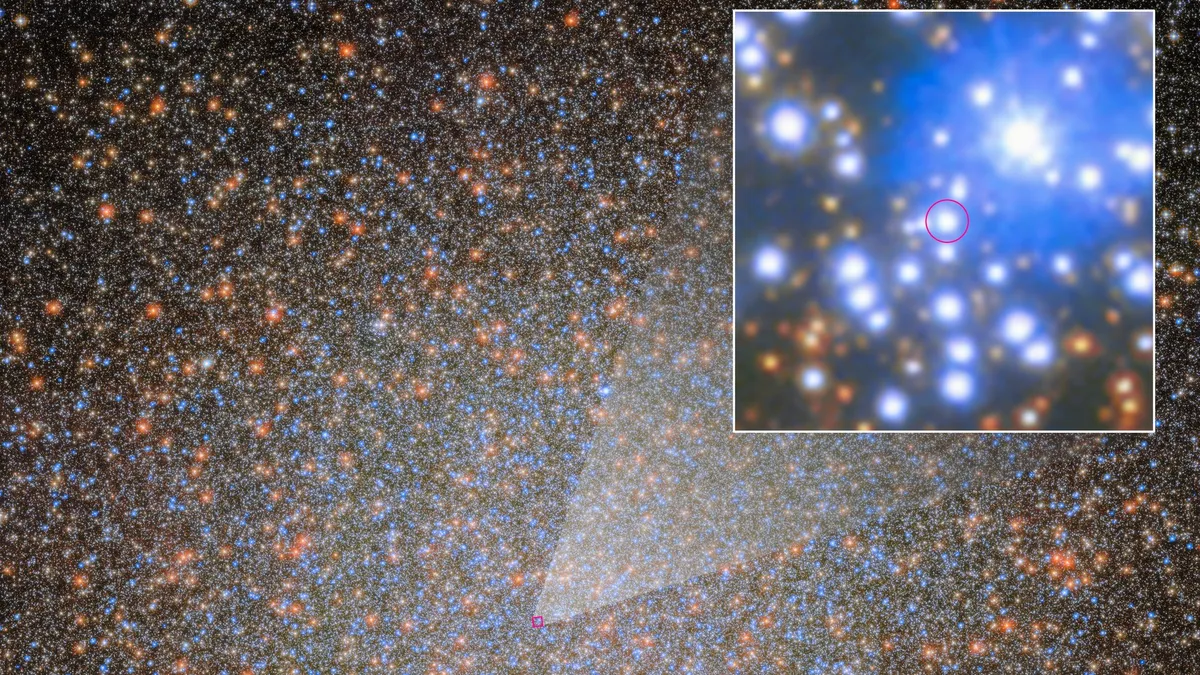
Astronomers using Hubble and JWST archival data have finally located oMEGACat BH-2, a stellar-mass black hole hiding in a cluster of 10 million stars.
The Discovery:
By tracking a star's orbit for 20 years, researchers proved it's circling an invisible object 4.46 times the mass of the Sun.
Image Credit: ESA, NASA, et al.
Understanding the Ultimate Gravity Engine.
Born from the collapse of massive stars ($>20 M_{\odot}$). Typically 3 to 100 times the mass of our Sun.
The "missing links" found in dense star clusters. $100$ to $100,000 M_{\odot}$.
Millions to billions of solar masses. Reside at the centers of nearly all large galaxies.
The spherical boundary where the escape velocity equals the speed of light ($c$). Nothing inside can ever communicate with the outside universe.
At the center, mass is crushed into an infinitely dense point. Curvature becomes infinite, and the laws of known physics cease to function.
"The place where spacetime ends."
General Relativity: Physics as Geometry.
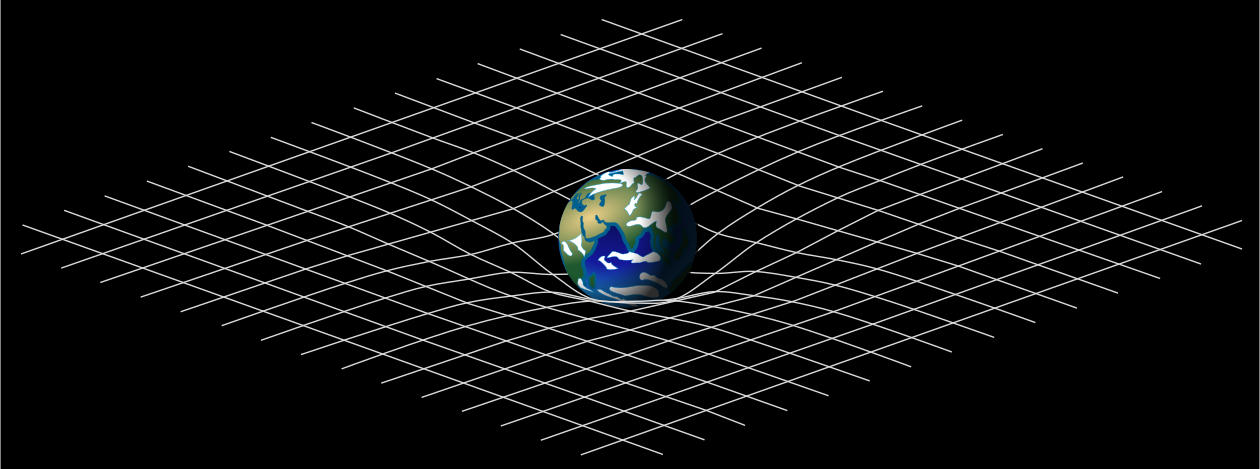
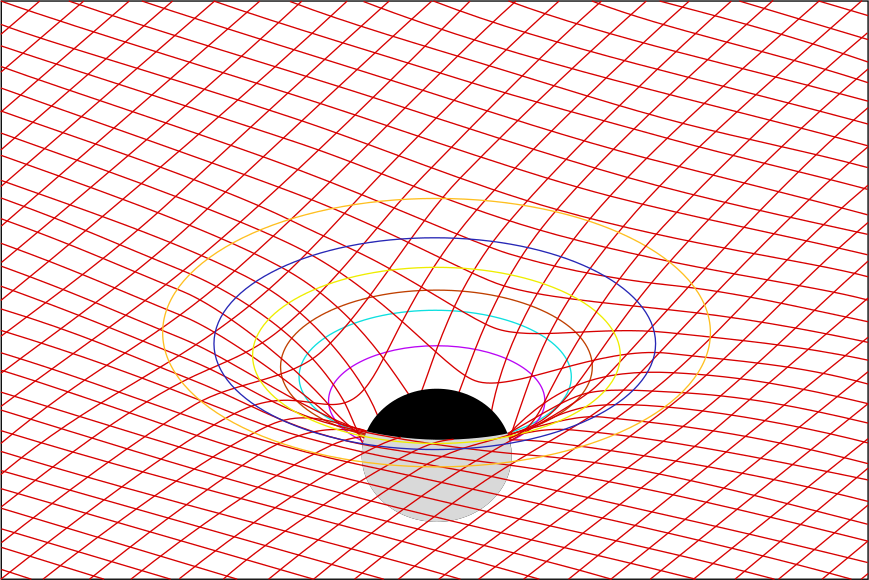
Einstein proposed that mass doesn't "pull" on other mass. Instead, mass warps the very fabric of space and time.
The metric tensor $g_{\mu\nu}$ defines the geometry of spacetime around a non-rotating mass.
| Metric Component | Physical Meaning | At the Event Horizon ($r = R_s$) |
|---|---|---|
| Temporal curvature (Time Dilation) | Vanishes ($g_{tt} \to 0$) | |
| Radial spatial stretching | Diverges ($g_{rr} \to \infty$) |
Note: This "divergence" is a coordinate singularity, not a physical one—you can fall through without hitting a wall!
As an object approaches the event horizon, an outside observer sees its clock slow down until it appears to freeze completely.
— Stephen Hawking (1942–2018)
The Einstein Field Equations (EFE) describe gravity as the curvature of spacetime caused by mass and energy.
In 1965, Roger Penrose proved that singularities are not just mathematical artifacts, but a robust and inevitable feature of General Relativity.
Key Contributions:
Image Credit: Johan Jarnestad/The Royal Swedish of Sciences.
Hawking showed that when quantum effects are considered, black holes are not truly "black"—they emit radiation and eventually evaporate.
Temperature is inversely proportional to mass. Smaller black holes are hotter and evaporate faster.
The Mechanism: Virtual particle pairs form near the horizon. One falls in, while the other escapes as radiation, carrying away a tiny fraction of the black hole's mass.
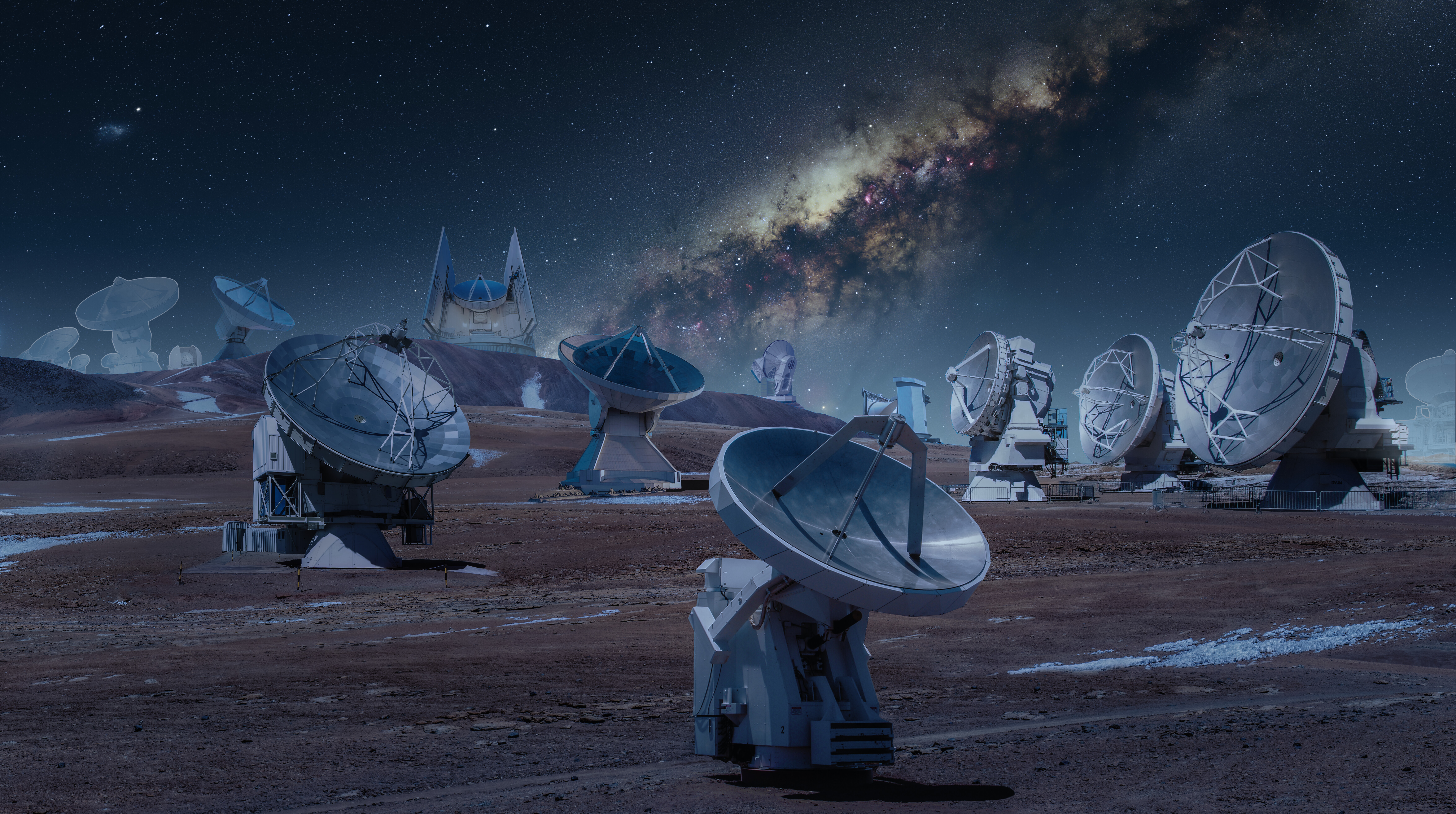
To photograph a black hole, we needed a telescope the size of the Earth. We built a virtual one using VLBI.
April 10, 2019: The first direct image of the black hole in the center of galaxy M87.
The dark "shadow" is the event horizon's silhouette, surrounded by a ring of light from gas traveling at nearly the speed of light. This observation provided the first direct confirmation of Einstein's General Relativity in the strong-field regime.
If a black hole evaporates via Hawking Radiation, what happens to the information (quantum states) of the matter that fell in?
Calculate the Schwarzschild Radius ($R_s$) of the Earth to determine how small it would need to be to become a black hole.
| Mass of Earth ($M$): | $5.97 \times 10^{24}$ kg |
| Constants ($G, c$): | $G = 6.67 \times 10^{-11}$ m$^3$ kg$^{-1}$ s$^{-2}$, $c = 3 \times 10^8$ m/s |
| Equation: | $R_s = (2 \times G \times M) / c^2$ |
Calculate the Schwarzschild Radius ($R_s$) of the Earth to determine how small it would need to be to become a black hole.
| Mass of Earth ($M$): | $5.97 \times 10^{24}$ kg |
| Constants ($G, c$): | $G = 6.67 \times 10^{-11}$ m$^3$ kg$^{-1}$ s$^{-2}$, $c = 3 \times 10^8$ m/s |
| Equation: | $R_s = (2 \times G \times M) / c^2$ |
Result: ~8.87 Millimeters
Conclusion: You would need to crush the entire Earth to the size of a marble.
NEXT WEEK: THE COSMIC SYMPHONY
Multi-Messenger Astronomy: Listening to Gravitational Waves and Neutrino Ghosts.